
If you’re aiming for a 40+ study score in VCE English, you’ve probably noticed that everyone online has a “secret strategy”. Memorise this one structure. Use this magic sentence. Write like this and you’re guaranteed a high score.
If any of that worked, examiner reports wouldn’t flag the same problems year after year. The calm, slightly uncomfortable truth is this: there’s no trick that replaces real preparation. Students who score 40+ don’t get lucky — they get systematically prepared. This article unpacks what that preparation actually looks like.
The one habit high scorers share
If you want a 40+, the single most effective thing you can do is complete practice exam after practice exam — properly.
Not once. Not twice. Consistently, strategically, and with feedback.
This isn’t a motivational slogan. It’s pattern recognition — the same skill the exam rewards. The more realistic papers you sit, the faster you recognise what a prompt is really asking, which ideas fit, and how to shape them under pressure.
Education researcher John Hattie’s large-scale work on what drives student achievement consistently ranks feedback among the most powerful influences of all. Which brings us to the key point:
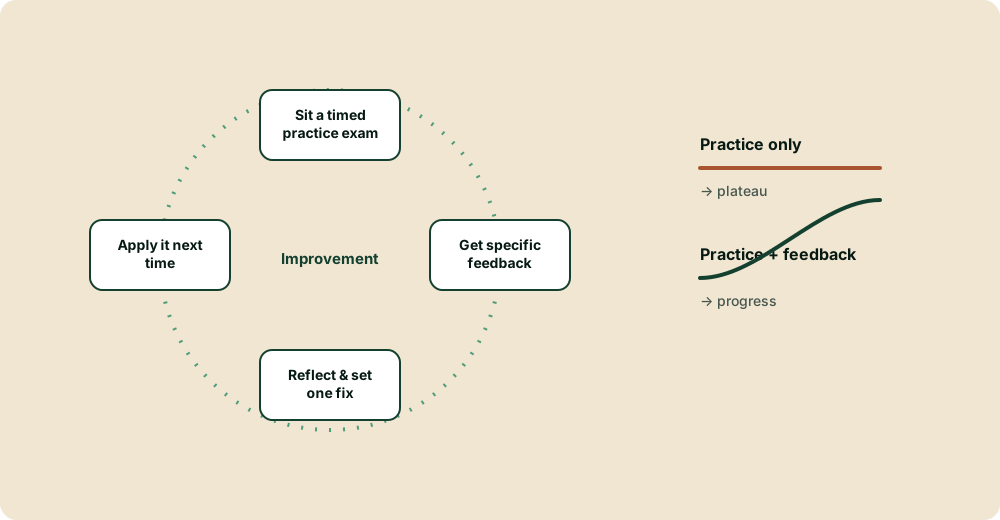
Practice alone doesn’t get results. Practice + expert feedback does.Why practice exams are non-negotiable
Sitting practice exams isn’t just revision — it’s training your brain for how the real exam works. Practice exams teach you to:
- interpret exam-style prompts quickly and accurately under pressure;
- allocate your time sensibly across all three sections;
- maintain quality when fatigue sets in; and
- adapt your ideas on the fly instead of regurgitating memorised essays.
You wouldn’t train for a marathon by reading about running. And you can’t prepare for VCE English by only “understanding the text”.
The catch: practice alone will plateau you
This is where a lot of strong students stall. They write essay after essay, receive minimal or vague feedback, improve at first… and then stop improving.
Comments like “be more specific”, “needs deeper analysis” or “evidence?” tell you that something went wrong — not how to fix it.
With only months (or weeks) until the exam, every practice piece needs to change how you write next time. If feedback leaves you more confused than when you started, it isn’t helping. It’s using up time you don’t have — and motivation drops fast.
What makes feedback actually useful
High-scoring students don’t just write more; they write smarter. Good, targeted specific, actionable expert feedback helps you:
- spot repeat weaknesses across multiple essays;
- adjust your paragraph structure strategically;
- improve your idea selection, not just your expression; and
- build confidence — and avoid exam-day writer’s block.
This matters more than ever, because the exam increasingly rewards conceptual sophistication and control rather than memorised responses.
Make every piece of feedback actionable
When you get a comment back, rewrite it as an instruction to yourself. “Needs deeper analysis” becomes “For every quote, name the technique, then explain the effect on the reader in one extra sentence.” Keep these instructions in a running list and re-read it before every practice exam.
Five ingredients of exam-ready preparation
1. A realistic exam environment
Exam anxiety isn’t a personality flaw — it’s unfamiliarity. When you repeatedly work under real timing, real pressure and realistic prompts, your nervous system adapts. By exam day, the experience doesn’t feel special; it feels familiar. Confidence is built through exposure, not affirmations.
2. Practice papers that mirror the real thing
Use practice exams that reflect the language, structure and conceptual framing of the real paper — not recycled generic essay questions. The closer your practice is to the real conditions, the more your preparation transfers.
3. Detailed, section-by-section feedback
Aim for feedback on all three sections, with clear next steps and strategy-based improvement points — ideally from someone who understands how marks are awarded, not just whether an essay “reads well”.

4. Writing stamina and mental endurance
The exam is long for a reason. Students routinely underestimate cognitive fatigue, the drop in clarity under pressure, and the burnout that hits in the final section. Full-length practice builds endurance, not just skill — you learn to keep your writing sharp when your brain wants to switch off. That is often the difference between a mid-30s response and a 40+ one.
5. Strategic reflection between exams
Top students don’t just do exams; they review the patterns. After each paper, ask:
Your post-exam reflection
Build this reflection into your routine and every exam makes the next one better.
How we spend our days is, of course, how we spend our lives.Annie Dillard, The Writing LifeHow you practise now shapes the result you walk out with later.
No shortcuts — but plenty of proven paths
There aren’t any shortcuts. There are, however, clear paths — walked successfully by students before you. The formula is simple:
Key takeaways
- High-quality, realistic practice exams.
- Exam-aligned strategy.
- Specific, actionable expert feedback.
- Consistent reflection between papers.
It isn’t glamorous. But it works. Your VCE English result won’t be decided on exam day — it will be decided by how you prepare in the months before it.
Explore exam preparation
Want structure, realistic practice papers and feedback that tells you exactly what to change? Explore The English Kit’s Exam Workshop, study guides and one-on-one VCE English tutoring.
Explore exam preparation →Quick answers
Do practice exams really improve VCE English results?
Yes — when they’re done under realistic timing and paired with specific, actionable feedback. Practice alone tends to plateau; practice plus feedback and reflection keeps you improving.
Why do my VCE English marks stop improving even though I write lots of essays?
Usually because the feedback isn’t specific enough to change how you write next time. Comments like “be more specific” identify a problem without showing the fix.
How do I build stamina for the three-hour VCE English exam?
Sit full-length practice exams under timed conditions regularly in the lead-up, so maintaining quality in the final section becomes familiar rather than exhausting.


