
In the middle of the school holidays and wondering how to balance rest with getting ahead? This one’s for you.
First, a note for the high-achievers who want to squeeze value out of every minute: rest is part of the plan. Taking time to recharge and reflect is what makes you productive when term returns. Like your future career, VCE is a marathon, not a sprint.
But in between the rest, the holidays are also a rare chance to quietly get ahead in ways that are impossible during a packed term. Think of it as your own training chamber: a focused stretch where a little work goes a long way. Here are four ways to use it.
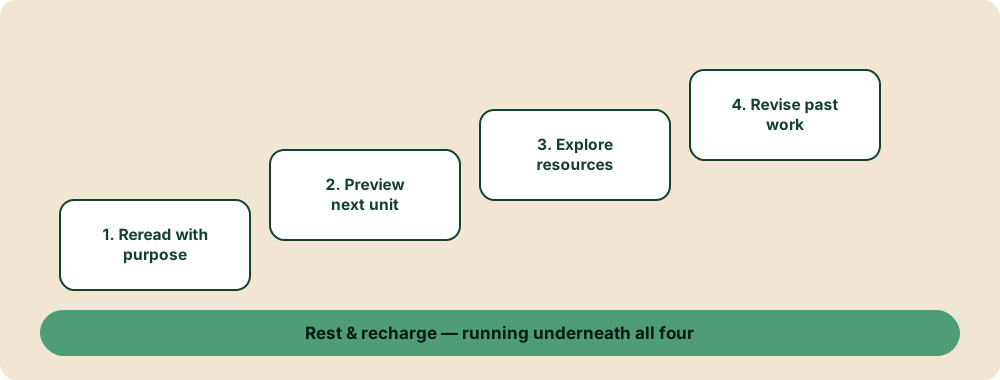
Step 1: Reread your texts — with purpose
The holidays are perfect for revisiting your set texts, but in a different way from how you read them during term.
If you’re still shaky on the plot: go back to basics and read (or rewatch) the text from start to finish. By exam time you should ideally have been through it at least twice — three times if you can. That way you’re not just remembering what happens; you’re internalising the world, the characters and their motivations.
If you already know the text well: switch gears to close analysis.
- For films, use CAMELS — Camera, Acting, Mise-en-scène, Editing, Lighting and Sound.
- For novels and plays, focus on symbols, metaphors and patterns in language.
Think of this as your active reading phase. You’re not summarising — you’re spotting the layers you missed the first time.
Step 2: Look ahead — preview your next unit
If your next area of study is Crafting Texts, the holidays are a golden opportunity to start planning early.
- Revisit your mentor texts. You’ll be drawing on the style, voice and ideas of your mentor texts, so start exploring them now. Note their tone, imagery and recurring motifs.
- Brainstorm your ideas. Jot down moments, themes or personal experiences you might write about. Crafting Texts rewards originality and reflection — the goal isn’t to copy your mentor’s voice, but to find your own within that framework.
Moving on to another area of study instead?
- Analysing Argument: review your persuasive techniques and tone words. Make flashcards or a “tone bank” so the vocabulary is ready when term starts.
- Text Response: start your next set text. Even one casual read-through gives you a major head start.
Step 3: Explore resources and build depth

Your local or state library is a treasure chest of English resources waiting to be opened.
- Academic journals and essays on your set texts — many are available free through state library online databases.
- VCAA examiner reports, which show what high-scoring responses look like and the mistakes examiners see most often.
- Study guides and critical articles to deepen your understanding of context, genre and authorial intent.
If your text is a widely studied one, there’s a wealth of scholarship out there. Reading even one or two critical essays can open up entirely new interpretations to draw on in your writing.
Step 4: Revise what you’ve already done
Before diving into new content, revisit your old work.
- Reread your essays and class notes from earlier in the year.
- Annotate your own writing. Highlight what worked — strong vocabulary, sharp analysis, a clear line of argument — and note where things fell flat.
- Revisit your creative drafts. Reflect on how your voice, tone or characterisation could evolve.
You’ll be surprised how much more you notice after a few weeks away. This consolidates your learning and builds a bank of phrases, structures and techniques you can reuse in future pieces.
Ask the Head Chef
Q: How can I assess and improve my own writing when I don’t have a tutor or teacher available?
A: Such a great question — and self-assessment is one of the most important habits top students develop. It forces you to step back and actually see your writing, rather than producing it on autopilot. The tricky part is knowing what to look for. Here’s a two-step framework that works:
- Gather benchmark samples. Collect essays or creative pieces across different mark ranges (the VCAA examiner reports are a good place to start). Compare them with your own work and see where yours sits.
- Build a self-marking checklist. Turn the official assessment criteria into questions — for example, “Does this response show a detailed understanding of the text?” or “Is the writing controlled and purposeful?” — and mark your own work through that lens.
You can also study model answers closely: how do top responses transition between ideas, embed quotes and unpack evidence?
Pro tip: you don’t always need an external marker, but having one piece professionally marked gives you a “reference essay” to measure all your future work against.
Build your self-marking checklist
Key takeaways
- Rest is part of the plan — don’t feel you need to study every day.
- Reread your texts with purpose: plot first, then close analysis.
- Preview your next unit, especially mentor texts for Crafting Texts.
- Use library databases and examiner reports to add depth.
- Revise and annotate your past work to build a reusable bank of strengths.
Final thoughts
You don’t need to study every day to succeed. But if you’ve got the energy and focus, these holidays can be the perfect window to level up. Reread your texts, explore your mentor works and polish your past writing — and you’ll walk into next term not just rested, but ready.
Get a reference essay marked
Want to know exactly where your writing sits? The English Kit offers tailored marking, study resources and one-on-one tutoring for VCE students.
Get a reference essay marked →Quick answers
How should I revise my VCE English texts over the holidays?
If you’re unsure of the plot, reread or rewatch the whole text. If you know it well, focus on close analysis — film techniques using CAMELS, or symbols, metaphors and language patterns in novels and plays.
How can I mark my own English essays?
Collect sample responses across different mark ranges, build a checklist from the official assessment criteria, and assess your own work through that lens. Having one piece professionally marked gives you a reliable reference point.
Should I study every day during the school holidays?
No. Intentional rest matters. A few focused sessions spread across the break is enough to get ahead without burning out.


