
Quotes are one of the most valuable tools in your English toolkit — and one of the most misused. Too many and your essay feels overloaded. Too few and it lacks evidence.
In this guide you’ll learn: the four main types of quotes and when to use each; how to analyse a quote instead of just dropping it in; and long-term habits to get ahead in VCE English, especially if you’re in Year 9 or 10 and aiming high.
The four types of quotes
Sorting quotes into categories helps you decide when and why to quote — and what to do with each one once it’s on the page.
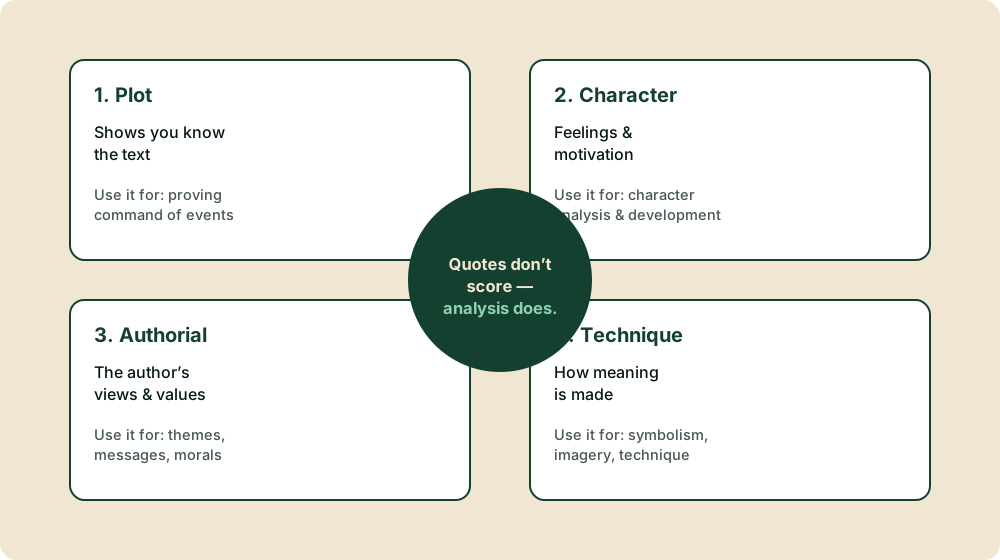
1. Plot quotes
These describe what happens. They aren’t deeply symbolic or emotional, but they prove you know the text inside-out — its structure, events and turning points. Use them generously.
“In Act II, when the table breaks in two, Annie discovers a secret compartment hidden inside. This represents…”
2. Character quotes
These reveal personality, motivation and development. Zoom in on specific word choices to expose emotional nuance or bias.
“When Jonathan describes Amy as a ‘lazy broad’, Cruz exposes the shoemaker’s deep disdain for women — a misogyny that eventually manifests violently by the novel’s end.”
3. Authorial quotes (views and values)
Sometimes the author’s own perspective shines through more strongly than any character’s. These quotes let you unpack themes, messages and moral positions.
“Wu’s description of the family house as the ‘little home of warm fires and easy chatter’ symbolises the home as a refuge for the Anaheim children — reinforcing Wu’s broader message about belonging and identity.”
4. Technique quotes (language and style)
These are your close-analysis gems. They show you understand how a writer creates meaning through style and structure — perfect for Text Response and Analysing Argument alike.
“In the poem, Vinheim describes broken glass as the ‘shattered signal of [his] starved cynicism’, with sibilant alliteration creating a spitting, angry tone that mirrors his frustration.”
Note: the texts and authors in these examples are illustrative.
The golden rule: quotes don’t score — analysis does
You don’t get marks for using quotes. You get marks for what you do with them. Every quote should deepen your analysis. Before you include one, ask yourself:
Does this quote earn its place?
If you can answer those questions, you’re already ahead of most students.
Build a quote bank early
Start a tagged quote bank for each text, with quotes tagged by type (plot, character, authorial, technique) and by theme. By exam time you’ll have a curated bank you can recall instantly — not a panicked scramble.
Ask the Head Chef

Q: What would you recommend doing in Year 10 to get ahead in English? And if you could restart from Year 9, how would you prepare for a 50?
A: Great questions — and ones I wish more students asked early.
If I could start again, I’d work backwards from what a raw 50 actually demands. That comes down to two things:
- Strong inputs — rich knowledge, wide reading and solid writing foundations.
- A refined process — the ability to turn those inputs into essays, paragraphs and sentences that stand out.
By the start of Year 12, aim to have a solid grasp of Text Response, Crafting Texts and Analysing Argument; experience writing each task type in low-pressure settings; and familiarity with a range of classic and contemporary texts. In Years 9–10, here’s how I’d build that foundation.
Text Response: build knowledge and curiosity
Become well-read and well-versed. Thomas C. Foster’s How to Read Literature Like a Professor is a brilliant starting point — treat each chapter as a mini creative project.
Try this: read the chapter on rain and snow, then write a short paragraph analysing snow as a symbol in something you’ve read or watched. Follow up on any texts or authors that spark your interest.
Crafting Texts: develop your voice
As your analytical writing improves, your creative writing will too. Reading a wide range of writers helps you discover your own voice.
Try this: read some prose by Helen Garner or Margaret Atwood. Notice their rhythm, tone and how their sentences sound. Borrow what works — style can be learned.
Analysing Argument: build instincts, not just notes
This area is skill-based. Rather than memorising lists of techniques, develop an instinct for spotting persuasion in the wild.
Try this: analyse opinion pieces, political posts or op-eds on trending issues. Ask: What’s the contention? Who’s the audience? How does the writer build credibility or emotion?
Do this consistently and analysis becomes second nature — and your future SACs will feel far less daunting.
Key takeaways
- Know the four quote types: plot, character, authorial and technique.
- Quotes don’t earn marks on their own — your analysis does.
- Unpack the specific words, not just the general idea.
- Start a tagged quote bank for every text early.
- In Years 9–10, build inputs (reading) and process (low-stakes writing) across all three areas of study.
Wrapping up
Quoting well is an art. You don’t need to memorise hundreds of lines — you need to know how to choose, analyse and connect them with purpose. It’s not about using more quotes. It’s about using the right ones, and knowing exactly why they’re there.
Get feedback on your analysis
Want someone to check whether your quotes are pulling their weight? The English Kit’s tutoring and marking can show you exactly where to sharpen your analysis.
Get feedback on your analysis →Quick answers
How many quotes should I use in a VCE English essay?
There’s no fixed number. Use enough to support every claim, but make each quote earn its place — the marks come from what you do with a quote, not how many you include.
What are the main types of quotes to use in a text response?
Plot quotes (showing you know the text), character quotes (revealing feelings and motivation), authorial quotes (revealing the author’s views and values) and technique quotes (showing how language creates meaning).
What should I do in Year 9 or 10 to prepare for VCE English?
Read widely, practise analytical writing on short texts, experiment with creative writing in the style of authors you admire, and get into the habit of analysing persuasive language in everyday media.


